How Much Space Do You Need Behind an Office Chair?
Use practical chair-clearance ranges for sitting, standing and through-traffic without treating a concept layout as a measured drawing.
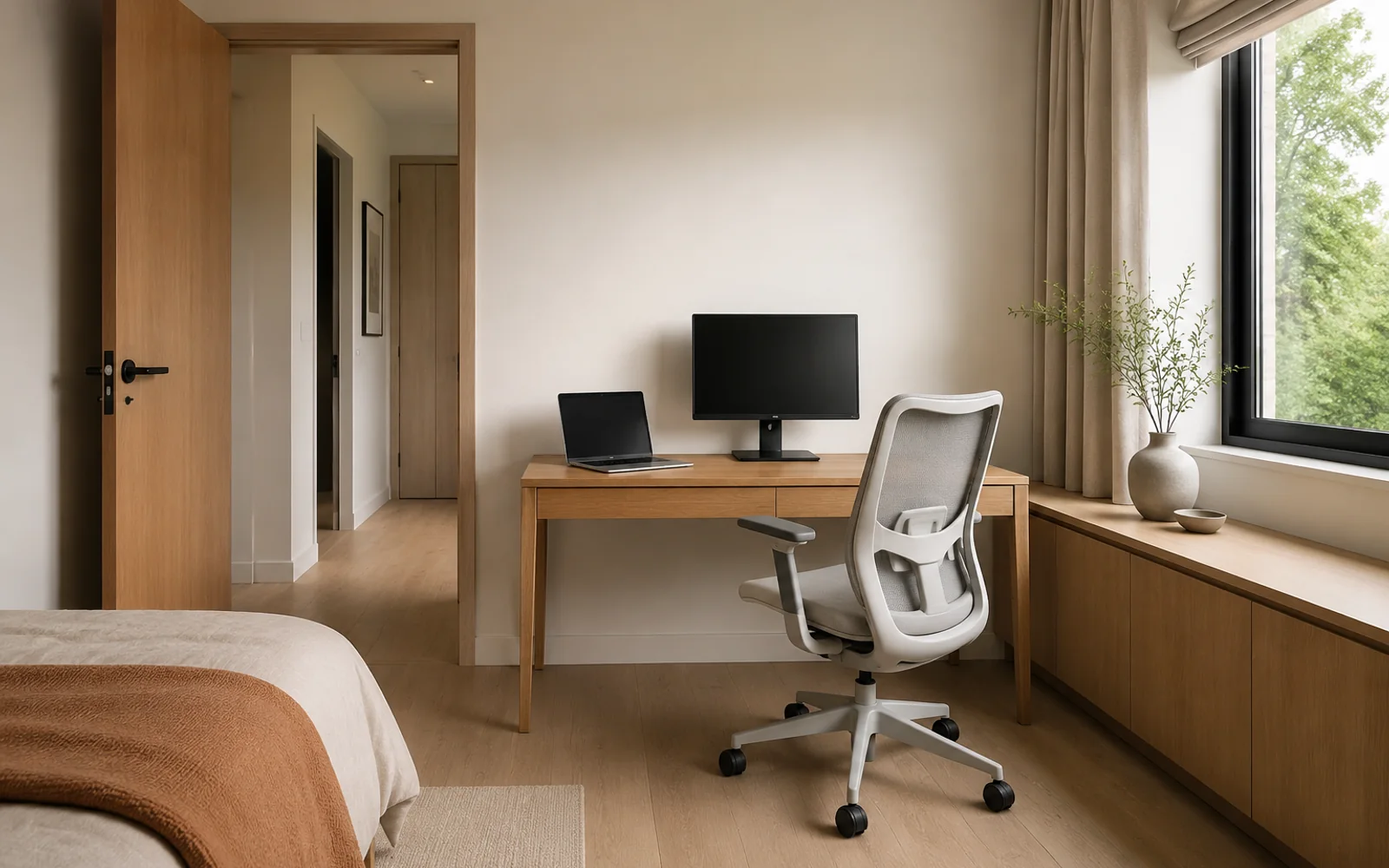
Allow about 90 cm / 36 in behind an office chair when the user needs to sit down and stand up comfortably. Increase that to roughly 105–120 cm / 42–48 in when another person must regularly walk behind the occupied chair. A compact setup can sometimes work with 75 cm / 30 in, but that is a tight clearance for occasional use, not a comfortable default.
These are planning ranges, not universal building rules. Chair depth, body size, desk height, wall trim, door swings and local accessibility requirements all change the answer. Measure the exact chair at its most extended position before buying a desk or fixing storage to the wall.
Three different clearances are often confused
Space for the chair itself
Measure from the front edge of the desk to the nearest wall or cabinet behind the chair. Include the chair base, not only the seat. Many ergonomic chairs extend farther back at the casters than they appear from above.
Space to stand up
The chair needs to roll back far enough for the user to rise without twisting around the desk. A shallow bedroom corner may fit the chair while seated but become frustrating every time the user stands.
Space for somebody to pass
If the route to a wardrobe, window or second workstation runs behind the chair, add a separate passage zone. Do not assume the passage and the moving chair can occupy the same space at the same time.
How to measure the real room
- Put masking tape on the floor for the proposed desk depth.
- Place the actual chair at a comfortable working distance.
- Roll it back as you would when standing.
- Measure the remaining path at the narrowest point.
- Open nearby doors and drawers fully and repeat the test.
A rug, thick skirting board or radiator can remove several useful centimetres. Also check the cable route: a power strip or floor cable directly behind the chair can turn an adequate clearance into a trip hazard.
Small rooms need explicit priorities
When space is limited, first protect the door and the route around the bed, then choose a shallower desk or closed wall storage. Reducing the chair movement zone should be the last compromise because it affects every working session.
The small home office design page shows a compact bedroom-corner example and the decisions used to preserve the chair path. The featured small-bedroom case makes the constraint visible instead of presenting a generic moodboard.
Use the home office layout planner when you want to compare desk, chair and storage zones in one bird's-eye concept. Add known room dimensions, but treat the output as a visual direction: it does not automatically measure the room or certify exact clearances.
Reviewed 17 July 2026. Verify the final layout against the actual chair, room and applicable local requirements.